


With Lafayette County and Oxford expanding, there has been a growing need for asphalt to create the new infrastructure. JW McCurdy plans to rezone 40 acres of land from A-1 Rural to I-2 Heavy Industrial to build a hot-mix asphalt plant.
“Asphalt production has gotten centralized down to a few giant producers,” a statement from Magnolia Materials said. “Monopolies mean higher prices, and monopolized markets result in buyers… simply being ‘told’ what they are going to pay. In a smaller county like ours, we have to compete with far bigger markets like Memphis, Nashville and even Tupelo for the limited production occurring in Mississippi.”
A local asphalt plant will reduce asphalt costs and have asphalt more readily available for the county.
“A modern, local source of asphalt strengthens the entire building and transportation network, making the County more attractive for investment and expansion,” a statement from Magnolia Materials said.
McCurdy sees a multitude of positive impacts the plant can provide, extending beyond just better infrastructure.
“This facility will serve contractors, developers and businesses across our community, helping drive down costs for construction and maintenance and supporting growth in housing, commercial development and public works,” Magnolia Materials said.
Despite these benefits, the Taylor community has many issues with the rezoning and has discouraged the passing of this rezoning. They have created a “Save Taylor” campaign in opposition to the rezoning.
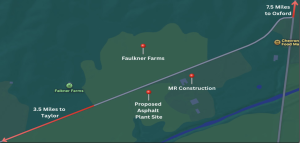
“The site is two miles from Taylor, next to Falkner Farms – a great local source of beef and fresh eggs – and near the Yocona River,” the Save Taylor website said.
The main concern is the location of the plant. There are limited options in where the plant can be built. The current site for the asphalt plant is located in a flood plane, which could cause issues for the surrounding town.
“Site selection for any new manufacturing venture is challenging as the site should both avoid residential areas but also have easy access to major highways,” a statement from Magnolia Materials said. “The ‘somewhere else’ is in one of the more densely populated areas of Oxford near almost 1,000 homes, schools and right next to an existing asphalt plant.”
This option for the site is believed to be the best out of the two. McCurdy reassured that precautions will be taken to prevent flood risk.
“State law already requires a 50-foot setback from the top of any riverbank, including the Yocona,” a statement from Magnolia Materials said. “That standard has protected Mississippi’s waterways for decades. This project goes far beyond that, with a 130-foot buffer – nearly triple what the law demands.”
Citizens are also concerned with traffic, the depreciation of the value of their property and possible pollution caused by the plant. McCurdy attempted to address these concerns at the Lafayette County Board of Supervisors meeting on Monday, Oct. 20.
“For this development, a traffic impact study will be required,” McCurdy said. “This study will assess the development’s effects on the street system and identify necessary improvements that will be needed. The local sales record near the existing asphalt plant shows substantial appreciation not depreciation [of property].”
McCurdy also addressed environmental concerns at this meeting, reassuring citizens that the plant would avoid as much pollution as possible.
“From an air quality standpoint, modern containment infiltration technology has resulted in an improvement of 99%,” McCurdy said. “The plant will use giant industrial air filters that filter these conditions. To reduce and avoid environmental impacts, we proactively hired an independent environmental consultant.”
Despite opposition from community members, there is large support for the plant from professional planners.
“We have the support of the Lafayette County planning director and staff,” McCurdy said. “The Lafayette County planning commission recommended approval of the rezoning, and we have the support of multiple planning professionals.”
Other than the risks for citizens, Faulkner Farms is the main business that could be affected by the rezoning. Faulkner Farms is located near the site and has been an important part of the Taylor community for years.
“We have been involved in business now for 12 years, so just supplying the community with fresh food, quality beef and eggs, for that length of time,” Reed Faulkner, co-owner and operator of Faulkner Farms, said.
Faulkner emphasized how important preserving agricultural land is because it cannot come back once it is gone. He argues that growing food for a community or family is essential.
“That is the whole point of our regenerative farm is to continue to preserve it, and then pass it on to the next generation and the next,” Faulkner said. “Just continue to educate and teach people how to provide for themselves and their community.”
Faulkner Farms could be driven out of business by this rezoning and construction due to the pollution.
“It’ll really affect us right across the road… from the noise and the pollutant and the flood risk in the trucks and traffic,” Faulkner said. “That’ll be how it bothers us with how we raise our livestock.”
The pollutants caused by the plant can harm livestock and affect the product Faulkner Farms is attempting to produce.
“The first thing with chickens is the stress levels can really rise based off of environmental factors,” Faulkner said. “The air quality is going to be a huge thing because their respiratory systems are very weak, and it would put them at risk, which would affect the overall product of the egg. It would be hard for us to sell, ethically, the beef that we are trying to produce and push as the healthiest option if there is a chance that it is tainted.”
Faulkner has become involved in the “Save Taylor” campaign by spreading awareness about the possible consequences of building the asphalt plant in this particular location.
“Think about what it is going to look like if we do have risk and problems and pollutants here that it turns into an uninhabitable and unusable property that was once doing good for the community,” Faulkner said. “It is just setting a huge precedent here that is a slippery slope.”
After much discourse, McCurdy has decided to look into another location for the plant.
“The developer behind a controversial proposed asphalt plant announced on Tuesday he will seek to build it in the Lafayette County Industrial Park, not in the small community of Taylor as originally planned,” as reported by MS Today News.